RESEARCH

RESEARCH

Customized Redox Mediator

Sens. Actuators Rep. 10, 100392 (2025)

Sens. Actuators Rep. 9, 100266 (2025)

Osmium redox complexes play a pivotal role as electron transfer mediators in a wide range of electrochemical systems. Osmium complexes can be precisely tuned by coordinating with various ligands, allowing control over their redox potentials and electrochemical properties to meet specific application needs. This flexibility enables highly efficient and stable electron transfer, making them suitable not only for enzyme-based systems but also for non-enzymatic and electrocatalytic platforms.

These complexes are used across many fields where electron transfer is essential — including medical diagnostics, biofuel cells, electrocatalysis, energy conversion, environmental monitoring, and food safety. Their tunable molecular structures and compatibility with diverse electrode materials and polymer matrices make them highly versatile from lab-scale research to commercial applications.

At CHEMBUD, we specialize in the design, synthesis, and production of osmium-based mediators customized to meet diverse scientific and industrial requirements. Through continued innovation and sustainable material technologies, we strive to be your trusted partner in powering next-generation sensors and energy systems.

Trace Metal Electrochemical Analysis

JACS Au 5(2), 1060-1068 (2025)

In the battery, semiconductor, and advanced materials sectors, trace impurities often have a critical impact on product performance and quality. Accordingly, the deployment of rapid and accurate on-site detection methodologies is essential.

CHEMBUD’s proprietary electrochemical sensing platform enables quantification of metallic species at parts-per-billion (ppb) levels with exceptional reproducibility. This technology is particularly well-suited for complex matrices, such as lithium-ion battery cathodes (NCM), which contain multiple metal ions—including nickel, cobalt, lithium, aluminum, manganese—and enable reliable detection of trace copper levels electrochemically.

To meet industrial process control requirements, CHEMBUD is developing innovative analytical systems, comprising multichannel potentiostats, electrochemical cells, and multi-electrode arrays, specifically engineered for in-line quality assurance during manufacturing. Beyond battery material applications, this platform underpins trace metal quantification across diverse domains, including medical-grade material certification, food safety analysis, and environmental monitoring, notably water treatment.

Fourier-Transform Electrochemical Impedance Spectroscopy
(FT-EIS)

Anal. Chem. 96(7), 3096-3106 (2024) ;

Anal. Chem. 92(15), 10504-10511 (2020)

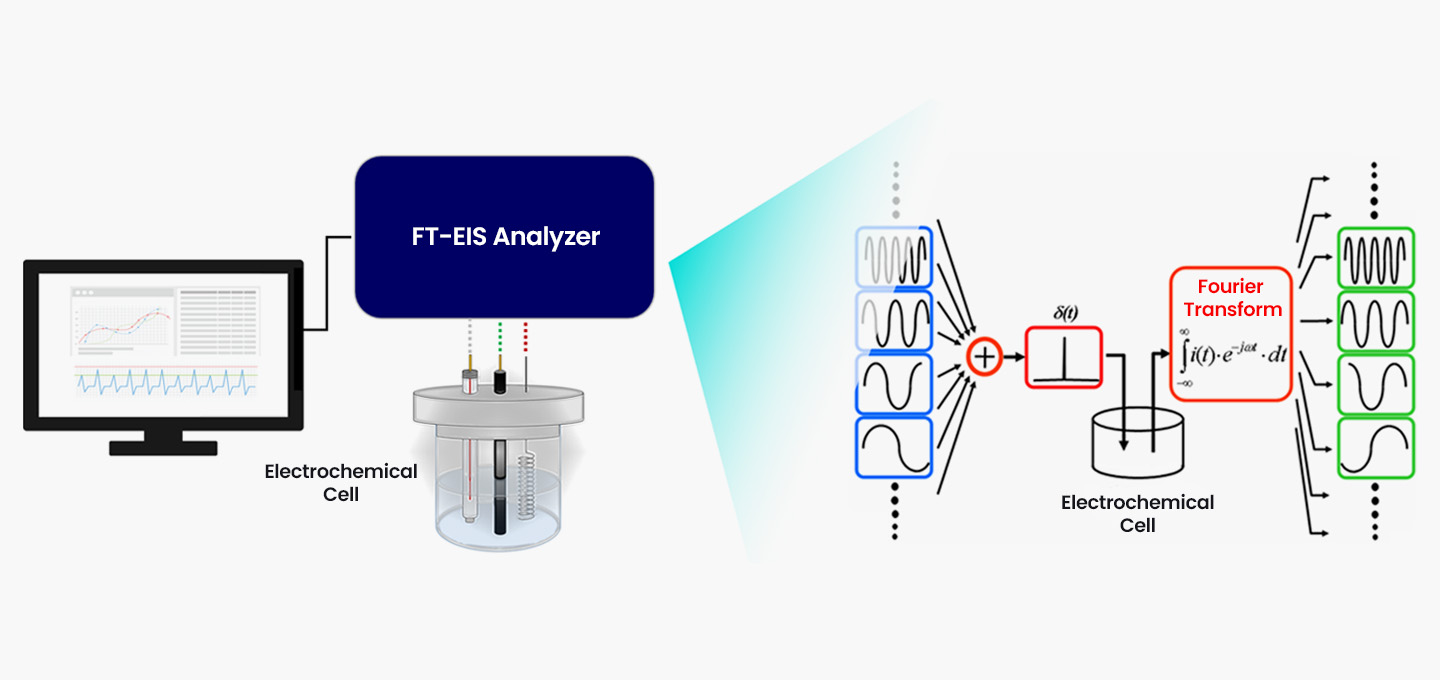
Fourier Transform Electrochemical Impedance Spectroscopy (FT-EIS), originally developed decades ago, is attracting renewed attention due to its capability to rapidly and accurately analyze electrochemical reactions on electrode surfaces. By simultaneously applying multiple frequencies and utilizing Fourier Transform, it delivers real-time impedance data with second-scale temporal resolution, offering a faster, less invasive alternative to conventional electrochemical techniques.

FT-EIS enables real-time monitoring of metal crystal growth within batteries, allowing for early detection of indicators of performance degradation or potential safety risks. This contributes to enhanced battery reliability and extended lifespan. The technology is also highly versatile, with promising applications in catalyst analysis, sensor development, and cutting-edge industries such as semiconductors and display technologies.

At CHEMBUD, we harness FT-EIS to deliver application-specific solutions across diverse sectors. As a leader in electrochemical innovation, we are committed to enabling a safer, more efficient future through next-generation technologies and scientific excellence.

IDA-based Immunosensor

Biosens. Bioelectron. 101, 317-321 (2018);

Anal. Chem. 86 (12), 5991-5998 (2014)

Modern medical diagnostic systems must simultaneously address diverse and complex demands such as prevention, personalized treatment, and public health response. Immunodiagnostic sensors have gained attention as point-of-care diagnostic tools due to their miniaturization, automation, and cost-effectiveness. When combined with high-sensitivity detection technologies, immunodiagnostic sensors are emerging as promising next-generation diagnostic platforms.

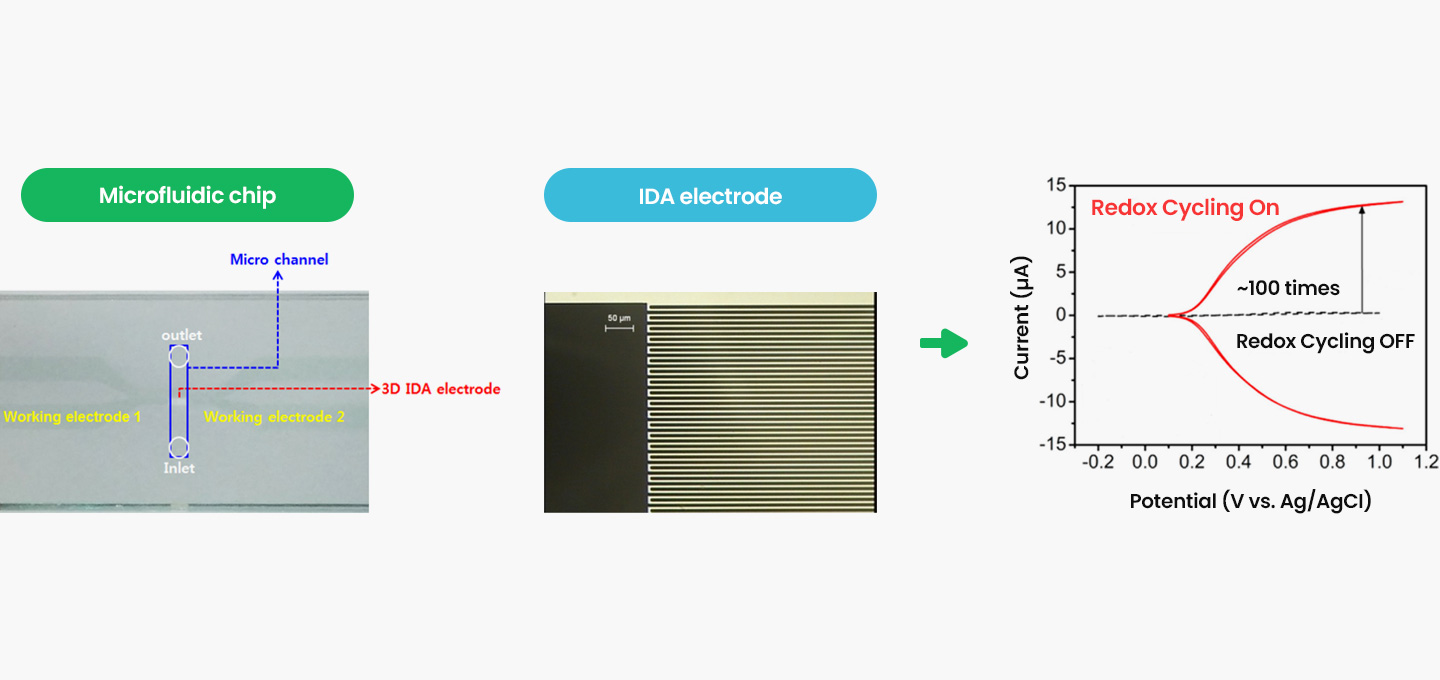
At CHEMBUD, we are developing an immunosensor based on a three-dimensional interdigitated electrode array (3D IDA). This sensor features a precise arrangement of electrodes within microchannels and leverages a redox cycling mechanism to amplify signals over 100-fold, enabling highly sensitive detection of ultra-trace biomarkers, including proteins and DNA, outperforming conventional sensors.

Our 3D interdigitated electrode array immunosensor leverages the synergistic interaction between redox mediators and the electrode’s structural features to maximize signal amplification. Its simple yet effective design enables easy integration into a variety of diagnostic platforms. These features position the sensor as a promising candidate for applications in point-of-care diagnostics, precision medicine, wearable devices, and healthcare sensors.